The word on the label — Parfum, EDP, EDT, EDC — describes how much fragrance oil the formula carries, and nothing more. Two bottles can carry the same oil load and behave completely differently, because performance is decided by which materials are in that oil, how volatile they are, and what the juice sits in. Treating the label as a performance promise is the most common mistake buyers make when they read a spec sheet.
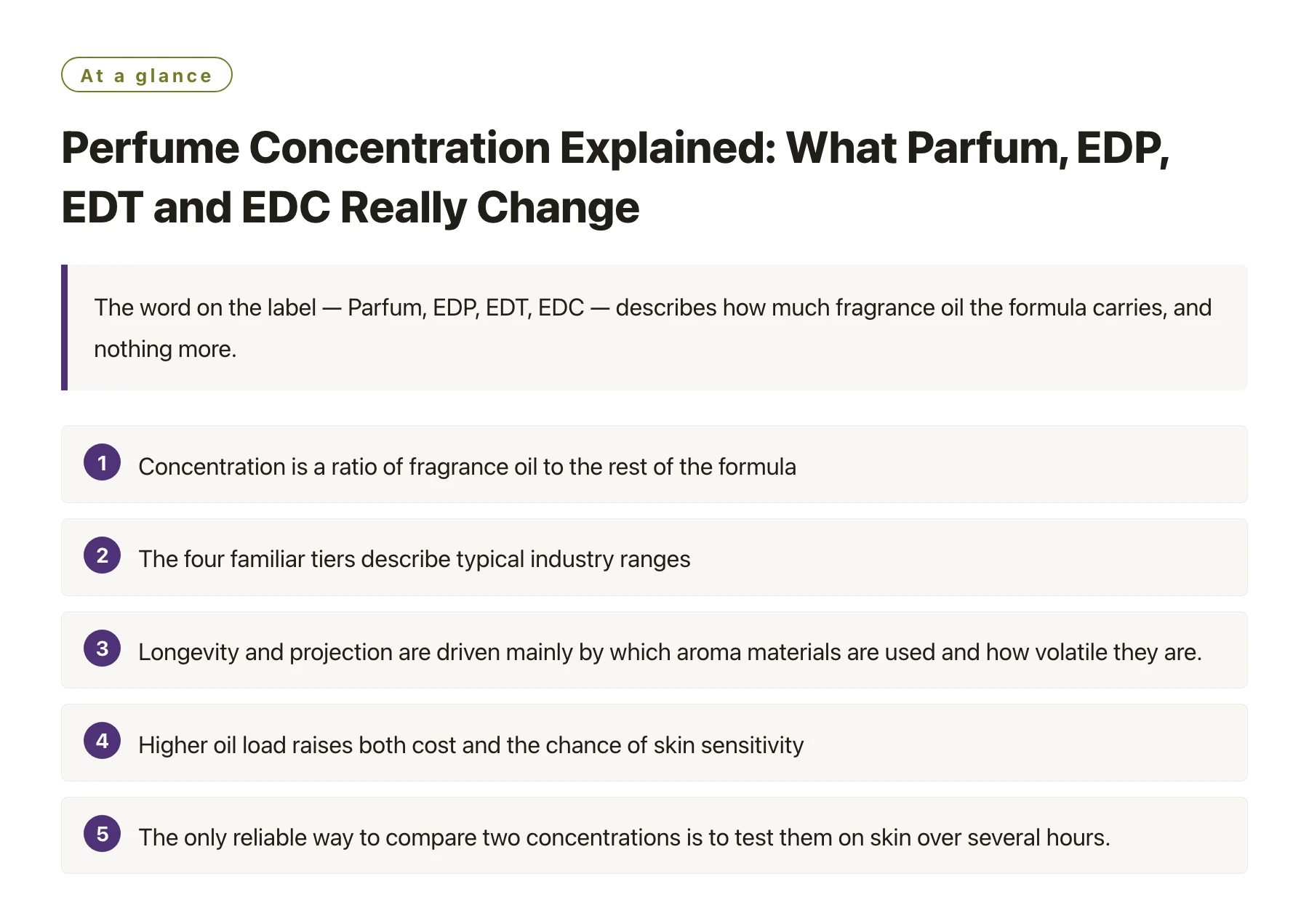
Key takeawaysConcentration is a ratio of fragrance oil to the rest of the formula, not a quality or longevity rating. · The four familiar tiers describe typical industry ranges, not fixed legal definitions, so brands can and do shift the line. · Longevity and projection are driven mainly by which aroma materials are used and how volatile they are. · Higher oil load raises both cost and the chance of skin sensitivity, which is why allergen labelling thresholds matter. · The only reliable way to compare two concentrations is to test them on skin over several hours.
Anyone sourcing a fragrance eventually meets the same chart: Parfum, Eau de Parfum, Eau de Toilette, Eau de Cologne, each with a percentage range next to it. The chart is useful as a starting vocabulary, and misleading as a specification.
The confusion matters commercially. If a brand owner specifies "EDP, 18%" expecting a certain wear time, and the perfumer delivers an 18% formula built on light citrus and fresh floral materials, the market will read the product as weak no matter what the label says.
This guide separates what concentration controls from what it does not, and shows how to use the tier system as a brief rather than a guarantee.
What the percentage on the label is actually measuring
A fragrance formula has two parts that matter for this discussion: the fragrance compound — the blended aroma materials — and everything that carries it, which is usually ethanol plus water, with fixatives and any functional ingredients the brief requires. Concentration is simply the fragrance compound's share of the total.
That number is a ratio. It says nothing about which materials were used, how strong each of them is, or how quickly they leave the skin. A 20% formula built on heavy woods and resins can sit closer to the skin and last longer than a 25% formula built on bright citrus, because the citrus materials evaporate long before the woods do.
Why the same percentage behaves differently
Aroma materials differ enormously in how strongly they are perceived. Some are detectable at a few parts per million, others need a much larger share of the formula before a nose registers them at all. Two formulas with identical oil loads can therefore land at completely different intensities.
Volatility adds a second variable. Top notes such as citrus and light herbs are small, fast molecules that leave the skin within minutes. Base materials such as musks, woods and resins are heavier and stay for hours. The ratio between those groups shapes the wear curve far more than the headline percentage does.
Where the familiar ranges come from
The tiers most buyers recognise — roughly 20 to 30 percent for Parfum, 15 to 20 for EDP, 5 to 15 for EDT and 3 to 5 for EDC — are conventions that emerged from European perfumery practice and are repeated across reference works and encyclopaedic summaries [1]. They are descriptive, not prescriptive: no cosmetics regulation defines them, and plenty of commercial products sit outside the bracket printed on their own category.
That flexibility is useful, and it is also why a label alone can never be used as a technical specification in a supply agreement. If wear time matters, it belongs in the brief as a target to be tested, not as a percentage.
What changes when you raise the load
Increasing the fragrance compound raises cost almost linearly, because the compound is the most expensive part of the bottle. It also increases the total exposure of the skin to the individual aroma materials inside it — which is where regulation comes in.
The International Fragrance Association publishes standards that restrict how much of a given material may be used, and in which product categories [2]. A higher overall load uses up more of those allowances. So the practical ceiling on concentration is often set by the most restricted material in the formula rather than by the perfumer's preference.

The four common tiers, and what each one is good for
| Tier | Typical fragrance compound | How it usually wears | Where it fits |
|---|---|---|---|
| Parfum / Extrait | 20–30% | Close to the skin, long tail, slower opening | Concentrated formats and evening lines where a slower reveal is wanted |
| Eau de Parfum | 15–20% | Moderate projection for the first hours, then a longer skin scent | The default for most fine fragrance launches |
| Eau de Toilette | 5–15% | Brighter opening, lighter presence, shorter tail | Daywear, larger formats, warmer markets and lower price points |
| Eau de Cologne | 3–5% | Fresh, immediate, brief | Refreshing formats, travel sizes and layering products |
| Body and hair mists | 1–3% | Light and fleeting | Line extensions that carry a scent signature at a low unit cost |
Read the table as a set of starting points rather than a rulebook. The column worth negotiating is the second one, because it is the input you actually pay for; the third column is the outcome, and it depends on the materials chosen. A short written brief that names the target wear time, the market and the price ceiling gives a manufacturer far more to work with than a single percentage.
How to specify a concentration for your own line
- Start from the wear experience, not the tierWrite down when the product should be noticed, how far it should carry and how long it should still be detectable. Those three sentences are the real brief.
- Name the market and the climateHeat and humidity change how a formula reads on skin, so the same juice can feel heavier in one market than another. Tell the perfumer where the product will be sold.
- Set the cost ceiling earlyThe fragrance compound is the most expensive input, so the target unit cost constrains concentration more than taste does. Fix the ceiling before sampling begins.
- Ask which materials are restrictedBefore approving a formula, ask which of its materials carry use restrictions and how much headroom is left. That is where reformulation risk usually hides.
- Test on skin, on more than one personPaper blotters show the opening; skin shows the dry-down. Run the sample on several people and check it at the two-hour and six-hour marks.
- Lock the formula, then the label wordingDecide the tier name only after the formula is fixed, so the label describes the product instead of arguing with it.
The most costly error in this part of a project is treating the tier name as a specification in the supply agreement and saying nothing about wear time. When the first bulk order arrives and the market reads the scent as too light, the disagreement is not about the formula — it is about expectations that were never written down. Fix it with one page: target wear time, target markets, unit cost ceiling, and the confirmed restricted-material headroom. Everything else in the fragrance brief can move; those four should not.
Where concentration stops explaining performance
Once a formula is fixed, three things outside the headline percentage decide how the product is actually experienced: the carrier, the application, and the packaging.
The carrier matters because ethanol and water ratios change how quickly the top of the formula lifts off the skin. The application matters because a spray delivers a different dose from a rollerball or a solid. Packaging matters because an open or poorly sealed format lets the formula change on the shelf.
Carrier and application change the dose
Two products with the same oil load can deliver very different amounts of fragrance per use. A fine mist spreads a thin film; a rollerball concentrates the same juice on a small area. Neither is better — but a brief that specifies concentration and stays silent on format has left the most visible variable unmanaged.
Allergen labelling follows the formula, not the tier
In the European Union, certain fragrance allergens have to be declared on the label once they pass set thresholds in the finished product [3]. Those thresholds are about the presence of specific materials, not about whether the bottle is called an EDP or an EDT, so the declaration list is a consequence of the formula you approve.
This is one practical reason to ask for the allergen picture before the formula is frozen. Changing it afterwards means re-labelling artwork and, in some markets, re-notifying the product.
Use the tier as vocabulary, not proof
The tier system survives because it gives buyers, perfumers and marketers a shared shorthand. It is worth keeping for exactly that reason, and worth distrusting whenever it is asked to stand in for a test result.
A manufacturer with a deep formula library can usually hit a target wear profile at more than one concentration, which is why the conversation is better framed as "what should this smell like at hour four" than as "make it a 20 percent EDP". For a worked breakdown of how the same framework plays out in practice, see how fragrance concentration changes performance.
Sources
- Wikipedia: Perfume —— An encyclopaedic overview of perfume covering definitions, history, the note structure of a fragrance and concentration terminology (background reference only).
- IFRA Standards Library (International Fragrance Association) —— The IFRA Standards Library lists the restrictions the fragrance industry applies to individual fragrance ingredients, based on safety assessments; it is the reference point for compliant fragrance formulation.
- EU Scientific Committee on Consumer Safety (SCCS) —— The EU scientific committee that issues opinions on the safety of cosmetic ingredients, including fragrance allergens and their labelling thresholds.
Frequently asked questions
Is Eau de Parfum stronger than Parfum?
Not necessarily. Parfum usually carries a higher share of fragrance compound, but perceived strength depends on which materials are in it. A well-built EDP with assertive base materials can read as more present than a Parfum built around soft, close-wearing notes.
Do the percentage ranges on concentration charts come from a regulation?
No. They are industry conventions that vary between sources and between houses. Cosmetics rules govern ingredient safety and labelling, not the name a brand gives to a concentration tier, so the ranges should be read as typical practice rather than as a legal definition.
Why does my sample smell weaker than the lab sample I approved?
Common causes are insufficient maceration time before filling, a different carrier ratio in the bulk batch, or evaporation during storage in a poorly sealed format. Ask the manufacturer to confirm the resting period and to compare the bulk batch against the approved reference.
Can a higher concentration cause skin irritation?
Higher oil load means more of every material in the formula reaches the skin, including any that carry use restrictions. That is why restricted-material limits and allergen thresholds are checked against the finished formula, and why the concentration ceiling is often set by the most restricted ingredient rather than by preference.
How many samples should a brand test before approving a formula?
Enough to see the dry-down on different skin types and in the markets you plan to sell in. Testing on paper shows the opening only; at minimum, evaluate each candidate on several people and check it at the two-hour and six-hour marks before deciding.